Route Planning Guide for Beginners | RouteFlow
Introduction
This Route Planning Guide for Beginners explains everything you need to know about planning efficient delivery routes, reducing mileage and improving productivity.
Whether you’re a courier, delivery driver, field service engineer, tradesperson, or small business owner, efficient route planning can save you hours every week while reducing fuel costs and vehicle wear.
Many drivers still plan routes manually using paper notes, spreadsheets, or multiple navigation apps. While this might work for a handful of stops, it quickly becomes inefficient as your workload grows.
In this beginner’s guide, we’ll explain what route planning is, why it matters, and how to build faster, smarter delivery routes using modern route optimisation tools.
What Is Route Planning?
Route planning is the process of determining the most efficient order to visit multiple locations during a journey.
Instead of driving from stop to stop randomly, route planning creates an organised route that reduces:
- Total mileage
- Driving time
- Fuel consumption
- Vehicle wear and tear
- Driver stress
For example, if you have 30 deliveries spread across a city, visiting them in the wrong order could add hours to your day. Proper route planning ensures each stop is visited in the most logical sequence.
For businesses that rely on deliveries, route planning directly impacts profitability, customer satisfaction and operational efficiency.
Why Route Planning Matters
Poor route planning affects more than just travel time.
It can lead to:
Increased Fuel Costs
Extra miles mean extra fuel.
Even a small reduction of 10–20 miles per day can save hundreds or even thousands of pounds per year.
With fuel often representing one of the largest operating expenses for delivery drivers and logistics businesses, route efficiency has a direct impact on profits.
Missed Delivery Windows
Customers increasingly expect accurate arrival times.
A poorly planned route increases the risk of late deliveries, missed appointments and unhappy customers.
Lower Productivity
The more time spent driving inefficiently, the fewer stops you can complete each day.
Efficient route planning helps maximise the number of deliveries completed during working hours.
Increased Vehicle Maintenance
Additional mileage creates unnecessary wear on:
- Tyres
- Brakes
- Suspension
- Engine components
Reducing unnecessary travel helps lower maintenance costs and extend vehicle lifespan.
Common Route Planning Mistakes
Many new delivery drivers make the same mistakes.
Planning Routes Manually
Using memory or manually ordering stops often results in unnecessary backtracking.
What looks efficient on paper may be far from optimal when viewed across an entire route.
Ignoring Traffic Patterns
A route that appears efficient may become problematic during peak traffic hours.
Understanding local traffic patterns is essential when planning deliveries.
Not Grouping Nearby Stops
Failing to cluster nearby deliveries can significantly increase mileage and waste valuable time.
Starting in the Wrong Area
Beginning with distant stops can create unnecessary travel later in the day.
A well-structured route often starts with deliveries that naturally lead into nearby areas.
Forgetting Time-Sensitive Deliveries
Certain deliveries must be completed before specific times.
Ignoring these requirements can result in failed deliveries, unhappy customers and operational issues.
What Is Route Optimisation?
Route optimisation is the process of automatically calculating the most efficient order to visit multiple locations.
Modern route optimisation software considers factors such as:
- Stop locations
- Driving distances
- Road networks
- Delivery deadlines
- Traffic conditions
- First stop requirements
- Last stop requirements
- Working hours
Instead of manually arranging 50, 100 or even 150 stops, optimisation software can generate an efficient route in seconds.
This saves significant time while often producing a better route than manual planning.
To see how modern route optimisation works in practice, explore the RouteFlow Features page.
Route Planning vs Route Optimisation
Many people use these terms interchangeably, but they are slightly different.
Route Planning
Choosing where you need to go.
Route Optimisation
Calculating the best order to visit those locations.
Think of route planning as creating the list and route optimisation as improving the order.
Both are important, but optimisation is what unlocks the biggest efficiency gains.
How to Plan a Multi-Stop Route
Step 1: Gather Your Stops
Collect all delivery addresses before starting.
Ensure postcodes and addresses are accurate to avoid navigation issues later.
Step 2: Define Your Start Location
This may be:
- Home
- Depot
- Warehouse
- Office
Using an accurate start location improves route calculations and ETA accuracy.
Step 3: Add Any Time Constraints
Examples include:
- Deliver before 10am
- Deliver before 12pm
- Afternoon-only deliveries
- Customer appointment times
These constraints help ensure important deliveries are prioritised correctly.
Step 4: Optimise the Route
Allow route optimisation software to determine the best stop sequence.
This is where the biggest efficiency gains are typically achieved.
Step 5: Review the Route
Check for:
- Unusual detours
- Missing stops
- Traffic concerns
- Customer-specific instructions
Step 6: Begin Navigation
Follow the route and monitor progress throughout the day.
Modern delivery apps can continuously update ETAs and route progress as work is completed.
Route Planning Example
Imagine you have 25 deliveries across a city.
Without route optimisation, you may simply visit stops in the order they were received. This often results in unnecessary backtracking and wasted mileage.
With route optimisation software, nearby stops are grouped together and arranged into the most efficient order.
The result:
- Fewer miles driven
- Lower fuel costs
- Faster completion times
- More deliveries completed
For drivers completing routes every day, even saving 15–20 miles per day can add up to thousands of miles saved over a year.
How Many Stops Can You Plan?
The answer depends on:
- Delivery density
- Traffic conditions
- Stop duration
- Vehicle type
- Route complexity
| Route Type | Typical Stops |
|---|---|
| Small local route | 10–20 |
| Standard courier route | 30–80 |
| High-density route | 80–150+ |
Modern route planning software can optimise routes containing hundreds of stops.
Understanding Delivery ETAs
ETA stands for Estimated Time of Arrival.
Accurate ETAs help:
- Drivers manage workloads
- Customers prepare for deliveries
- Businesses improve service levels
Advanced route planning software continually updates ETAs throughout the day based on actual route progress.
This provides a more realistic picture of expected arrival times and helps drivers stay on schedule.
Proof of Delivery and Route Planning
Efficient delivery operations require more than navigation.
Proof of Delivery (POD) provides evidence that deliveries were completed successfully.
Common POD methods include:
- Customer signatures
- Delivery photos
- Delivery notes
- GPS timestamps
Maintaining digital proof of delivery protects both drivers and businesses from disputes and provides valuable delivery records.
Learn more about RouteFlow’s Proof of Delivery features.
Benefits of Digital Route Planning Software
Modern route planning tools provide significant advantages over manual planning.
Save Time
Optimisation can reduce route planning from hours to seconds.
Reduce Mileage
Better routing means fewer unnecessary miles.
Increase Deliveries
More efficient routes allow drivers to complete additional stops.
Improve Customer Satisfaction
Accurate ETAs and reliable deliveries improve customer experience.
Gain Better Visibility
Analytics and reporting help identify opportunities for improvement.
Businesses using modern route optimisation software often experience significant improvements in efficiency and productivity.
Why Route Planning Matters for Small Businesses
Route planning is not just for large logistics companies.
Small businesses can benefit significantly from route optimisation by:
- Reducing fuel expenses
- Increasing daily capacity
- Improving customer satisfaction
- Reducing overtime costs
- Improving delivery reliability
As businesses grow, efficient routing becomes increasingly important for maintaining profitability.
A business that saves even 10% on mileage can see substantial savings over the course of a year.
Choosing the Right Route Planning App
When evaluating route planning software, look for:
Route Optimisation
Automatic stop ordering based on efficiency.
Driver Navigation
Built-in navigation designed specifically for delivery routes.
Live ETAs
Dynamic arrival time calculations.
Proof of Delivery
Photos, signatures and delivery notes.
Route Analytics
Performance reporting and route history.
Scalability
Support for larger routes as your business grows.
Choosing the right software can significantly improve both driver productivity and business profitability.
You can compare all available tools on the RouteFlow Features page.
Why Drivers Choose RouteFlow
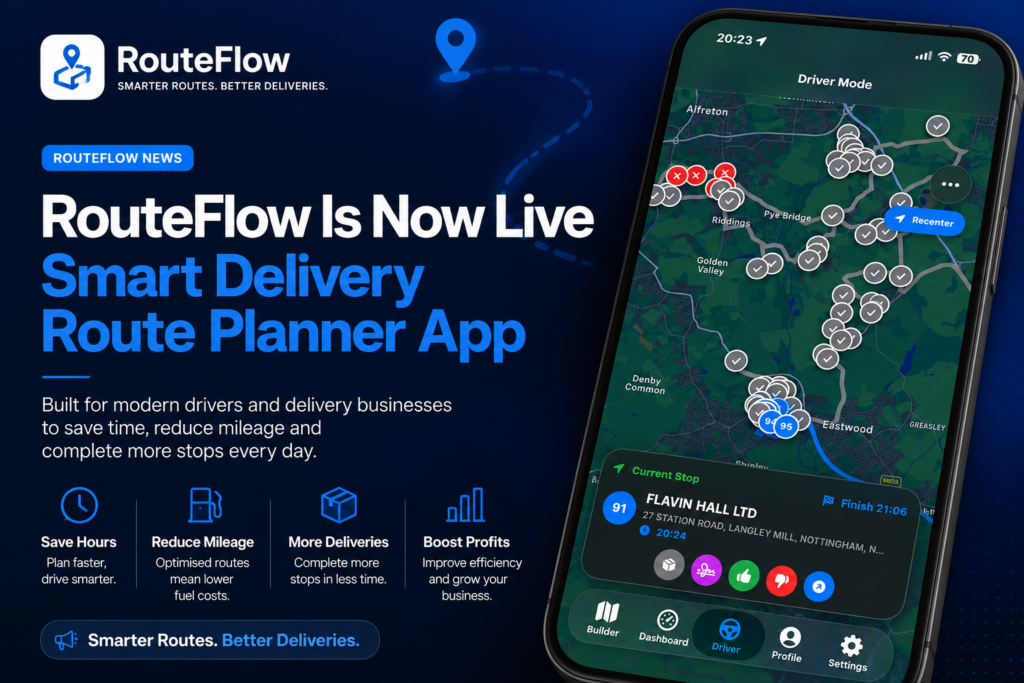
RouteFlow combines route optimisation, Driver Mode, Proof of Delivery and route analytics into a single platform designed specifically for delivery drivers and logistics businesses.
Features include:
- Multi-stop route optimisation
- Driver navigation
- Live ETAs
- Proof of Delivery
- Route history
- Performance analytics
- PDF reporting
Whether you’re delivering 10 stops or 100+, RouteFlow helps streamline every stage of the delivery process.
Explore the full feature set on our Features page or view available plans on our Pricing page.
The Future of Route Planning
For official UK transport and business guidance, visit GOV.UK.
Route planning technology continues to evolve rapidly.
Emerging innovations include:
- Artificial intelligence route analysis
- Dynamic traffic adaptation
- Driver performance insights
- Automated manifest imports
- Predictive ETA calculations
- Intelligent route recommendations
Businesses that embrace modern route planning tools will continue gaining competitive advantages through lower costs and greater efficiency.
For official UK business and transport guidance, visit GOV.UK.
Frequently Asked Questions
How many stops can route planning software handle?
Most modern route planning tools can optimise dozens or hundreds of stops depending on route complexity.
Can route optimisation reduce fuel costs?
Yes. By reducing unnecessary mileage and avoiding backtracking, route optimisation can significantly lower fuel consumption.
What is the difference between route planning and route optimisation?
Route planning determines where you need to go. Route optimisation determines the most efficient order to visit those locations.
Do I need route planning software for a small number of stops?
Even drivers completing 10–20 stops per day can benefit from improved efficiency and reduced mileage.
Is route optimisation useful for small businesses?
Absolutely. Route optimisation can help small businesses save money, increase productivity and improve customer satisfaction.
Final Thoughts
Route planning is one of the most important skills for delivery drivers and logistics businesses.
A well-planned route reduces fuel costs, saves time, improves customer satisfaction and allows drivers to complete more work with less stress.
Whether you’re managing ten stops or one hundred, investing in proper route planning and optimisation can dramatically improve your daily operations.
The best route is not always the shortest route—it’s the route that helps you complete your work efficiently, reliably and profitably.
As delivery expectations continue to rise, effective route planning is no longer a luxury. It is an essential part of running a successful delivery operation.
Ready to Optimise Your Routes?
RouteFlow helps delivery drivers, couriers and logistics businesses save time, reduce mileage and improve productivity.
With route optimisation, Driver Mode, Proof of Delivery and route analytics all in one app, RouteFlow is designed to simplify every stage of the delivery process.
Start your free trial today and discover a smarter way to plan, optimise and complete your routes.
About RouteFlow
RouteFlow is a route optimisation and delivery management platform built for delivery drivers, couriers and logistics businesses. The app helps users plan routes, navigate efficiently, capture proof of delivery and analyse performance.